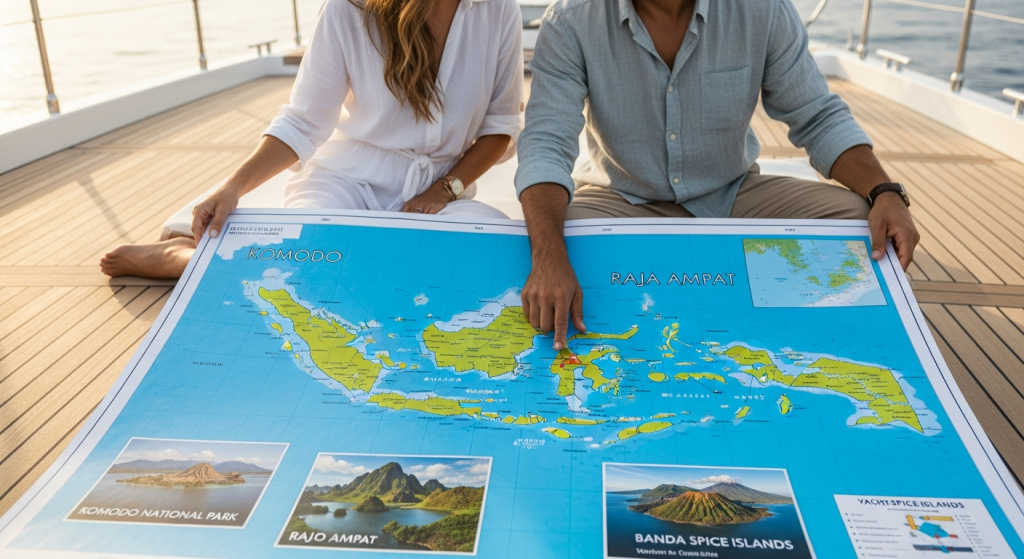
- Directly reaches remote dive sites and untouched natural reserves.
- Ensures absolute privacy and a fully customizable itinerary.
- Features expert local crew and specialized expedition amenities.
The scent of salt and frangipani drifts across the deck as a phinisi glides through a calm channel. Sunlight warms the polished teak, painting the distant emerald islands in sharp relief. This is the promise of Indonesia, a vast marine frontier where discovery unfolds on your terms. For discerning travelers seeking to navigate this intricate realm, the choice of vessel and method defines the journey.
The Unrivaled Access of an Indonesia Yacht Charter
Choosing an Indonesia yacht charter provides direct, intimate access to the archipelago’s most pristine and remote locations. Unlike land-based options, a private yacht serves as a mobile base, eliminating daily transfers and maximizing time spent exploring. Consider Komodo National Park, a UNESCO World Heritage Site since 1991, where a yacht positions guests moments from encounters with the Komodo dragon (Varanus komodoensis) on Rinca or Padar islands. A typical charter allows multiple dives daily at sites like Manta Point or Batu Bolong, where currents attract pelagic species. Raja Ampat, often called the “epicenter of marine biodiversity,” presents similar advantages; a yacht navigates the intricate Wayag lagoons and anchors directly above reefs teeming with 75% of the world’s hard coral species. The flexibility is absolute: alter course for an unexpected whale shark sighting in Cenderawasih Bay or extend a dive at a newly discovered macro site near Misool. A luxury phinisi, built by Buginese and Makassarese craftsmen, often measures over 50 meters in length, yet draws a shallow enough draft to access coves unreachable by larger vessels. This bespoke mobility ensures deep immersion into regions where land infrastructure remains minimal, offering a profound connection to Indonesia’s natural wonders.
Luxury Land-Based Resorts: Confines and Comforts
Luxury land-based resorts in Indonesia, while offering exquisite comfort and established amenities, inherently limit the scope of exploration. Properties like Amanjiwo in Central Java or Nihi Sumba on Sumba Island provide top-tier service, private villas, and curated land excursions. Guests enjoy predictable schedules, fixed dining options, and access to spas or fitness centers. However, their geographic permanence restricts spontaneous marine exploration. To reach dive sites from a resort on Bali, for instance, requires daily boat transfers, often shared with other guests, consuming valuable time. A journey from a resort in Labuan Bajo to the distant reaches of Komodo National Park can involve hours of travel each day, rather than waking directly at the site. The privacy, though high within a villa, diminishes in communal areas like restaurants or pools. While a resort may offer a “taste” of the local environment, it largely insulates guests from the raw, dynamic beauty of Indonesia’s marine ecosystems. A week at a top-tier resort might cost upwards of $15,000, yet the scope of experience remains tethered to its immediate surroundings, contrasting sharply with the boundless horizon a yacht presents.
Expedition Cruise Lines: Scale Versus Intimacy
Expedition cruise lines operating in Indonesia, such as those by Silversea or Ponant, offer structured itineraries across multiple destinations. These vessels typically accommodate 50 to 200 passengers, providing a comfortable, organized way to see various islands. Onboard lecturers and naturalists enhance the educational aspect, and the logistics of inter-island travel are managed by the crew. However, the scale of these operations inherently sacrifices intimacy and customization. Schedules are fixed, dictated by port calls and passenger rotations. A large ship cannot access the same shallow anchorages or secluded bays as a private yacht. Dive operations are often conducted in groups, adhering to strict time limits. For a research expedition or a family seeking absolute solitude, the presence of dozens or hundreds of other guests fundamentally alters the experience. While a week-long cruise might begin at $10,000 per person, the per-day cost often reflects a less personalized service model and a less flexible itinerary. The experience remains a curated tour, not a private exploration.
Bespoke Itineraries and Exceptional Privacy
The core advantage of an indonesia yacht charter rests in its capacity for bespoke itineraries and exceptional privacy, especially relevant for UHNW yacht buyers, family-office clients, and marine-bio research trips. Imagine designing a 14-day itinerary that precisely aligns with specific interests: a focus on macro photography in Triton Bay, followed by cultural exchanges with indigenous communities in the Banda Spice Islands, then dedicated periods for deep diving in Raja Ampat. This level of granular control is impossible with any other travel modality. A luxury phinisi like M/Y Dunia Baru or M/Y Lamima operates with a guest-to-crew ratio often exceeding 1:1, ensuring discreet, attentive service. A private chef crafts menus tailored to dietary preferences and gourmet standards, utilizing fresh, local ingredients. For a family reunion or a high-level corporate retreat, the entire vessel becomes a private domain, free from external intrusion. Research teams benefit from dedicated onboard labs, specialized equipment, and the ability to remain at a specific research site for extended periods, collecting data on specific coral species or marine populations. The investment, often upwards of $100,000 per week for a premier vessel, reflects this absolute control and exclusivity.
Operational Excellence and Safety Standards
Selecting an Indonesia yacht charter demands scrutiny of operational excellence and safety standards. Reputable fleet operators prioritize certified crews, adherence to international maritime regulations (such as SOLAS and ISM where applicable for larger vessels), and robust safety protocols. Dive masters onboard hold PADI or SSI certifications, ensuring safe and guided underwater experiences, even for advanced technical dives reaching depths of 40 meters. Vessels undergo regular inspections and maintenance, often exceeding national requirements. For marine-bio research trips, this translates to reliable equipment, experienced expedition leaders, and the ability to operate safely in remote, unchartered territories for weeks on end. A well-managed charter company provides detailed pre-trip briefings, emergency communication systems, and contingency plans for medical evacuations, often collaborating with international medical services. For example, a multi-week expedition through the Maluku islands requires meticulous planning, from fuel and provisions to satellite communications and medical kits, all managed by an experienced captain and operations team. This operational rigor ensures a seamless and secure experience across vast distances, enabling a focus on discovery rather than logistics.
The Definitive Choice for Indonesian Exploration
The decision to pursue an Indonesia yacht charter represents a definitive commitment to exceptional exploration and a deeply personal journey through one of the world’s most vibrant marine environments. While land-based resorts offer comfort and expedition cruises provide convenience, neither delivers the bespoke freedom, absolute privacy, or direct access inherent in a private yacht. From the ancient volcanic landscapes of Komodo to the vibrant coral gardens of Raja Ampat, the archipelago unfolds uniquely when approached from its waters.
Discover the possibilities for your next Indonesian expedition. Explore our fleet and custom itinerary options at indonesiayachtcharter.com, or contact our charter specialists to begin planning your bespoke voyage.