
Routes & Itineraries
Remote Fuel Stops: Where Expedition Yachts Refill Beyond Bali
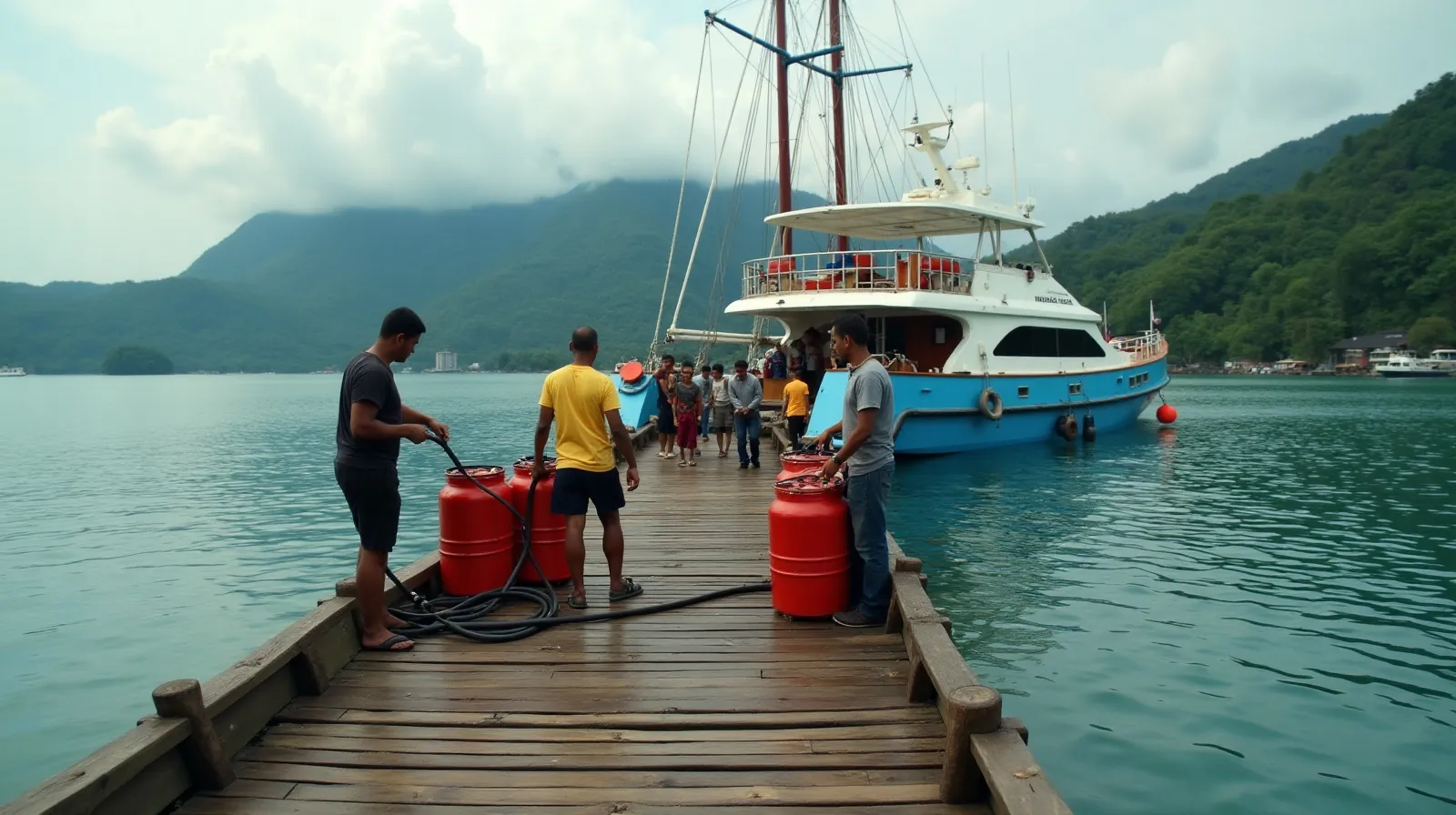
East of Bali, marine diesel stops being a dockside commodity and becomes route-planning input. The archipelago’s expedition legs are shaped by a short list of reliable fuel points — and by the drum-and-barge improvisation that bridges them. This is the fuel map that sits underneath the planner’s expedition routing, and the reason vessel tankage matters as much as cabin count out east.
The fuel map, west to east
| Stop | Method | Reliability |
|---|---|---|
| Benoa (Bali) | Fuel dock, bunker barge | Full service, duty options for departing yachts |
| Labuan Bajo | Barge / jerry-can fleet | Good; book ahead in Jul–Aug |
| Makassar | Commercial dock | Good; industrial quantities |
| Kupang | Truck-to-wharf | Fair; staging for Timor routes |
| Ambon | Truck / drum | Fair; the Banda gateway load |
| Ternate | Drum | Fair; North Maluku’s only point |
| Sorong | Barge / drum | Good; Raja Ampat’s tank |
| Kaimana / Nabire | Drum only | Order days ahead |
How drum fuelling actually works
Beyond the docks, fuel arrives as 200-litre drums on a truck, a wooden jetty, or a lashed-alongside canoe — hand-pumped or gravity-fed through the vessel’s own filtered transfer rig. A 10,000-litre top-up this way is a half-day evolution and a spectator sport for the village. Crews order through local agents days ahead, verify quantity drum by drum, and treat the operation as seamanship rather than errand. It is slower and costs a margin over posted prices — the honest cost of cruising water this remote.
Quality control: the non-negotiables
Expedition crews run a fixed protocol: pre-filter every litre (water-separating funnel filters at minimum, polishing rigs on serious vessels), sample and settle drums before transfer, dose biocide against tropical diesel bug, and keep tanks pressed full overnight to limit condensation. Fuel quality east of Makassar is generally workable but variable — the protocol exists for the one drum in fifty that is not. A blocked filter bank mid-passage in the Banda crossing is the scenario the whole discipline prevents.
What this means for route and budget
Fuel geography writes three rules into every eastern itinerary. Range margins: captains plan legs at 60–70% of theoretical range, keeping a weather reserve. One-way logic: routes end at fuel points (Sorong, Nabire, Kupang) rather than doubling back. And APA weighting: fuel is the single largest APA line on expedition legs, which is why identical vessels price differently by region — the mechanics are itemised in the cost guide’s APA section. None of this constrains a well-planned charter; it is simply why the planning is worth paying for.
The economics and etiquette of drum fuel
Drum fuel runs on relationships as much as logistics. The agent who assembles forty drums on a Kaimana jetty has called suppliers in three towns, hired a truck, and staked his reputation on the delivery date; the crews who thrive out east treat that service accordingly — orders placed early, quantities honest, payment prompt, and a fair margin accepted as the cost of remoteness rather than negotiated into resentment. The margins themselves are modest in context: even at frontier premiums, fuel remains a fraction of an expedition charter’s daily rate, and the alternative — carrying every litre from Sorong — costs range and trim. Seasoned captains split the difference: full tanks at real fuel points, drum top-ups planned at two or three relationship stops per season, and a reserve calculated for the route’s worst plausible detour.
The transfer itself has a choreography worth watching: drums sounded and sampled before lifting, funnels with water-separating filters staged, deck scuppers plugged, absorbent mats laid, and a crewman on the jetty keeping tally against the manifest. A clean forty-drum evolution finishes in an afternoon and leaves no sheen on the water — the standard the good fleets hold themselves to, park waters or not.
Practical notes on fuel planning east of Bali
- Planning ratio: legs at 60–70% of theoretical range; weather reserve is not optional east of Alor.
- Ordering lead: 2–3 days for Labuan Bajo barge slots in peak season; up to a week for frontier drum assemblies.
- Quality protocol: sample and settle every drum, pre-filter every litre, biocide on schedule, tanks pressed full overnight.
- Documentation: fuel receipts ride the APA reconciliation — itemised, at cost, with the handling margin visible.
- Generators: house loads matter — budget 15–25% of burn for hotel power on full-service vessels.
- Emergency margin: know your route’s bailout ports (Bima, Kupang, Tual, Ternate) and the range to each at economical speed.
Fuel geography is the least romantic layer of expedition routing and the most honest: it decides what is possible before any brochure does, and mastering it is what separates operators who promise the far east from those who deliver it.
Quick answers
Where can yachts refuel in eastern Indonesia?
Reliable points are Labuan Bajo, Makassar, Kupang, Ambon, Ternate and Sorong, with drum-only service at frontier stops like Kaimana and Nabire. Everything else is agent-arranged improvisation.
Is fuel quality a problem in remote Indonesia?
It is variable enough that crews pre-filter everything, settle drums before transfer and dose biocide routinely. With the standard protocol, problems are rare; without it, one bad drum can block a filter bank mid-passage.
Why do expedition charters cost more per day?
Fuel is the largest APA line on remote legs — drum fuel carries handling margins, and long distances between stops mean vessels carry and burn more. Range margins and one-way routing add to the load.
Related briefs
Continue with Village Protocol at Anchor guide and Routes North of Makassar.
Want this route priced for your dates? Message the Indonesia Yacht Charter desk on WhatsApp +62 811-3941-4563 or email [email protected] for routes, vessels and honest USD quotes within 48 hours.

Chart your Indonesian passage
Tell us your dates, group and the water you want under the keel. The desk replies on WhatsApp with routes, vessels and an honest USD quote.